In 1985, a 25-foot tower went up at the edge of the Stillwater-Northfork wetland, in a quiet bay of Monroe Lake. Over five years, from 1985 through 1989, crews brought 73 young eagles from Wisconsin and Alaska to that platform and cared for them there until they could fly. Before then, Indiana's last recorded successful bald eagle nest was in 1897.
The eagles that nest at Lake Monroe year-round trace back to that project. Each winter, birds from farther north join them, and the best time to see both starts in December. The lake's well-known eagle weekend comes in mid-February, near the end of the season. If you live within a short drive of the water, you don't have to wait for a festival. A boat ramp, a thermos and the right hour of the morning will do.
Why the Eagles Came Back to Monroe
The tower worked because of how eagles choose a home. Jill Vance, the interpretive naturalist at Monroe Lake, explained it to the Indiana Daily Student: eagles treat the place where they first flew as home, and they come back there to nest after several years as adults. Southern Indiana had no young eagles making first flights, so nothing pulled adults back to nest. "So, (the DNR) started releasing eagles here at Monroe Lake, and eventually they started coming back here to nest," Vance told the IDS. "Since that time, they've kind of hopscotched out from Monroe as the starting point."
The lake was part of the reason too. The Army Corps of Engineers began building Monroe Lake in 1966, one of several southern Indiana reservoirs that again gave eagles places to feed and nest, and in 1972 the United States banned nearly all uses of DDT. Vance told the IDS that the big reservoirs, with their large backwater areas, are what led the state to pick this spot for the reintroduction.
According to Monroe Lake's Eagle Viewing Guide, the first nest in Indiana appeared at Monroe Lake in 1989, and the first chicks hatched there in 1991. The program's goal was five successful nesting pairs within 15 years. By 2000, Indiana had 16 successful nests, and they had fledged 35 eaglets. At the start of 2021 the state had more than 350 nests, and bald eagles came off Indiana's list of species of greatest concern. The Indiana DNR's bald eagle page puts the count at more than 350 nesting territories statewide in 2020.
December Is When the Count Climbs
Monroe Lake has eagles all year. Vance told the IDS in February 2025 that the lake had about 12 to 16 active nests year-round, and that the local population can roughly triple in winter as eagles from farther north move south. She called December through the end of February a great time to watch eagles at the lake.
The birds go where they can eat. The DNR says wintering eagles stay near open water so they can fish, and that they like to spend the day perched in mature trees along large stretches of open water. The Herald-Times reported the same thing at Monroe: patches of open water in winter draw eagles looking for fish and waterfowl.
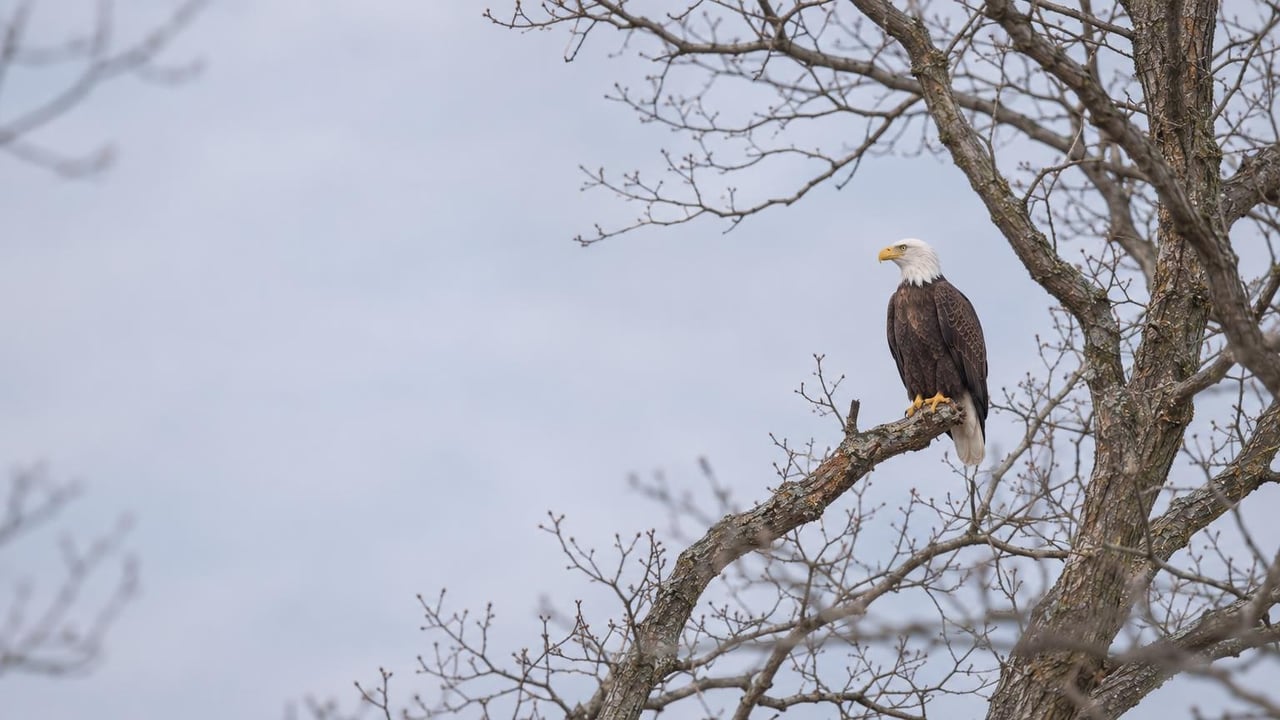
Once the leaves drop, the birds are also easier to find. The lake's viewing guide says eagles spend about 90% of their time perched, so a bare shoreline tree with a white head in it shows up from a long way off. The same guide says winter eagles are most active in the two hours after sunrise and the last two hours before sunset. On a weekday, that means a stop on the way to work, or a short drive out after an early dinner.
The Spots the Lake's Own Map Ranks First
The Eagle Viewing Guide is a map from Monroe Lake that sorts viewing points into two tiers. The first tier has six places:
- Paynetown SRA, Marina Peninsula
- Pine Grove SRA, Boat Ramp
- Cartop SRA, Shoreline
- Army Corps of Engineers Office, Overlook
- Fairfax SRA, Beach Peninsula
- Cutright SRA, Boat Ramp
The second tier adds the boat ramps at Paynetown, Allens Creek, Fairfax, Salt Creek and Moores Creek, along with Pointe Road Bay and the overlook at the Stillwater-Northfork Waterfowl Area. That last one stands at the wetland where the hacking tower was built. If you have time for only one history stop this season, make it that overlook, where Indiana's eagle comeback started.
A first-tier spot at the right hour is likely to show you more birds than a second-tier spot at noon. Bring binoculars. The birds you're looking for will usually be sitting still, so scan the tree line along the water slowly.
Vance has also seen a change that matters if you're walking a shoreline. She told the IDS that eagles once abandoned nests, even with eggs or newly hatched chicks, when people walked close by, so nests around the lake tended to sit in backwater areas with very little human activity. Through her monitoring, she has noticed that eagles have grown more used to people over the last decade or so. Even so, give a nest plenty of room and watch from a distance.
What's Open Between Now and February
Winter changes what you'll find at the recreation areas. The Indiana DNR lists the Paynetown SRA Activity Center as closed from November to late May, except for scheduled programs. Plan on a car, a coat and whatever you carry in, not an indoor stop with exhibits.
For a walk in the woods with your eagle watching, the Forest Service's Hardin Ridge Recreation Area on the lake closed its campgrounds for the season on Oct. 25, 2026. According to the Hoosier National Forest's Hardin Ridge page, its boat ramp, trails and day-use areas stay open with no fees until early April 2027. Hardin Ridge isn't on the eagle guide's list. It is a quiet, free place to stretch your legs on the same water during the months the eagle count is at its highest.
If you have family in town this Thanksgiving weekend, a drive around Paynetown and Fairfax is an easy way to get everyone outside after a big meal. It also lets you check where to park and where the views open up before December starts.
The February Weekend, for Context
Eagles Over Monroe is how most people around Bloomington hear about the lake's eagles. Vance told the IDS that it revives an event that ran in the 1990s and 2000s as Eagle Watch Weekends. She brought it back in 2017 under the new name. She changes many of the individual programs each year to give people a reason to come back, and keeps standards like the sunset eagle watches and the self-guided tour.
The most recent one ran Feb. 13 to 15, 2026, the Herald-Times reported. That weekend had a warming station at Paynetown on Feb. 13 and 14 and a free self-guided driving tour on Sunday, Feb. 15. It also had live bald eagle presentations at Paynetown at 2 p.m. and 4 p.m. on Saturday, Feb. 14, at $5 per person with a limit of 40 people per session.
Local groups help put on the shows. The IDS reported that Wild Birds Unlimited in Bloomington sponsors the presenters and birds for the live bald eagle shows, with proceeds going to the raptor rehabilitation center at Hardy Lake. The Sassafras Audubon Society, Bloomington's chapter of the Indiana Audubon Society, sponsors the live raptor shows featuring hawks, owls and falcons.
The February weekend is the best time of year to hear the naturalists and see an eagle up close. The rest of the season starts next week and runs for about three months, from the Paynetown peninsula to the Cutright ramp, and you can go whenever you like.
At The Evans Realty Group, we love how much of Lake Monroe carries on through the winter, from the first migrants in December to the February eagle weekend. If you're wondering what living closer to these mornings on the water might look like, or which side of the lake suits your routine, we're glad to listen and share what we know. Let's Start a Conversation.